
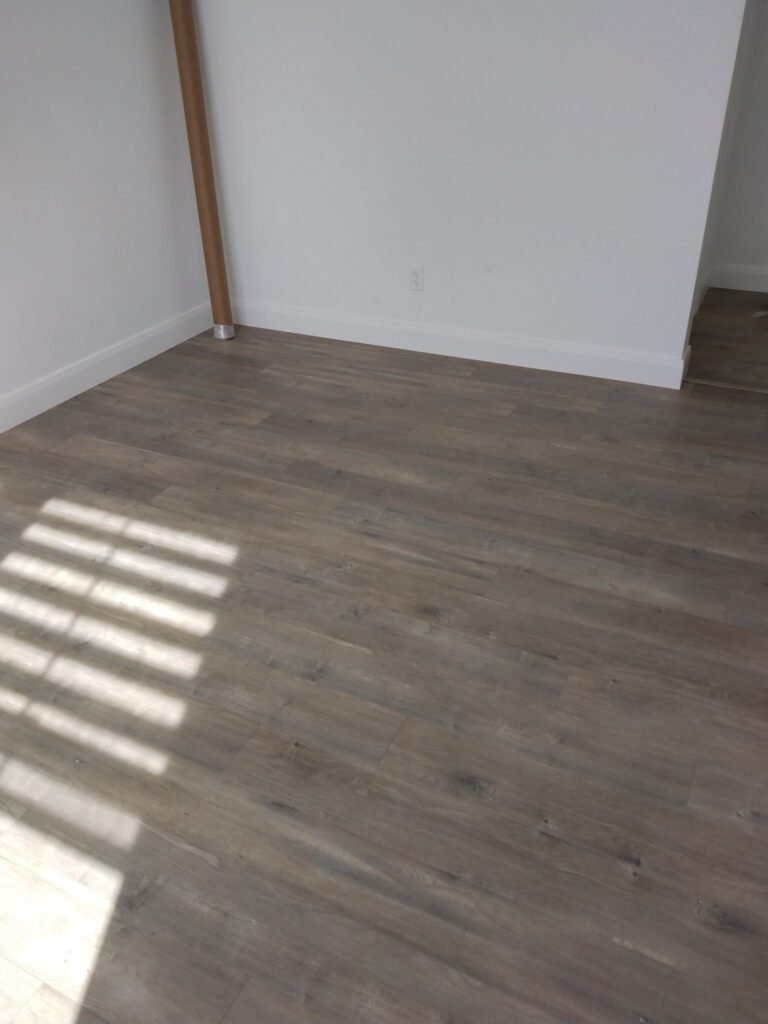
LVP and laminate look similar in a showroom — both come in wood-look planks, both click together, both cost less than hardwood. In a real house, though, they behave very differently, especially around water. Here’s the honest comparison from someone who installs both across the Treasure Valley.
What each one actually is
LVP — luxury vinyl plank — is a vinyl plank with a rigid core. The wear layer on top takes the scratches; the core underneath doesn’t swell when it gets wet. That’s the whole selling point: it handles kitchens, bathrooms, mudrooms, and pets without the worry.
Laminate is a fiberboard core with a printed wood image on top. It’s hard, it looks good, and it’s usually cheaper per square foot on material. But that fiberboard core is wood-based, and wood-based cores swell at the seams when water sits on them. A spilled glass wiped up fast is fine. A slow leak under a dishwasher or a dog water bowl that sloshes daily is how laminate edges start to peak.
Cost in Boise
Installed LVP typically runs $5–9 per square foot all-in — material and labor together, with most homes landing somewhere in that range depending on the product and the subfloor. Labor-only for LVP or laminate runs $2–3 per square foot, with a $650 minimum job.
Laminate material is usually cheaper than LVP plank for plank, so a laminate job often comes in lower on total price for the same rooms. If budget is the deciding factor and the rooms are dry — bedrooms, living rooms, hallways — laminate is a legitimate way to save money without a bad floor.
Water, pets, and daily life
This is where the decision usually gets made. LVP wins anywhere water shows up: kitchens, bathrooms, laundry rooms, entries, and any house with dogs that come in wet from the yard. It also handles sliding furniture and high traffic well, and most LVP products are quieter underfoot than people expect.
Laminate wins on feel in dry rooms — it feels a bit more like wood underfoot than vinyl does, and the hard surface resists dents from dropped objects. But it needs you to respect water: wipe spills promptly, don’t wet-mop it, and don’t put it in a bathroom with a shower unless you accept the risk at the seams.
What the subfloor has to be
Both floors need a flat subfloor, and this is where cheap installs fail. LVP shows every hump and dip — a wavy subfloor telegraphs right through the planks and the click-lock joints start to separate. Laminate is a little more forgiving over minor unevenness but still needs the same flatness check. Before either floor goes down, the subfloor gets checked with a straightedge, high spots get ground down, and low spots get filled. Skipping that step is how you get a floor that clicks, flexes, or gaps within a year. We cover the install standard on our LVP installation page.
Which rooms get which
- Kitchen, bathroom, laundry, entry: LVP. Water wins this argument every time.
- Bedrooms, living room, hallway: either. Laminate saves money here; LVP keeps one consistent floor through the whole house, which a lot of homeowners prefer.
- Basements on concrete: LVP, with a moisture test on the slab first. Laminate over a damp slab is asking for swollen seams.
- Stairs: either can work, but stairs are trim-heavy and labor-intensive — price them separately from the flat rooms.
The short version
If you want one floor through the whole house and you never want to think about water, go LVP. If the budget is tight and the rooms are dry, laminate is a solid floor that looks great and costs less. The wrong move isn’t picking either one — it’s putting laminate where water lives, or installing either one over a subfloor nobody checked.
FAQ
How much does LVP cost installed in Boise?
Typically $5–9 per square foot all-in, depending on product and subfloor condition. Labor-only runs $2–3 per square foot with a $650 minimum.
Is laminate cheaper than LVP?
Usually, yes, on material. Labor is the same range for both. The total gap depends on the product you pick.
Can laminate go in a kitchen?
It can, but it’s a risk at the sink and dishwasher. If you do it, wipe spills fast and never wet-mop. Most homeowners who ask us end up choosing LVP for kitchens.
Does LVP need underlayment?
Most rigid-core LVP has an attached pad. On concrete, a moisture barrier matters more than extra cushion — we test the slab before deciding.
How long does an install take?
Most single-room jobs are a day. A full main floor is usually 2–3 days, plus trim and transitions.
Run your square footage through our flooring cost calculator for a ballpark, or request a quote through the site. Call Boise Home Flooring at (986) 273-5409. We install across Boise, Meridian, Nampa, Eagle, Star, Kuna, and Caldwell.
Boise Home Flooring, a division of Boise Epoxy Flooring Co. LLC — licensed and insured, Treasure Valley local, 18 years in the trades. Flooring install, tile, baseboards and trim.
Pingback: LVP Flooring Installation in Nampa, ID - Boise Home Flooring
Pingback: Can You Install LVP Over Tile or Old Floors?
Pingback: Is LVP Really Waterproof? The Slab Truth